Hyrveliq
Cipher Deck
Cipher Deck
Couldn't load pickup availability
-
Problem Statement
After working with beginner materials, many learners can understand small examples but feel unsure when code becomes longer. A page with several sections, repeated blocks, and many CSS rules can start to feel difficult to follow. Class names may look random, spacing rules may become messy, and styling choices may be copied without understanding why they work. This can make practice feel disconnected, especially when learners want to build pages that look more organized. Cipher Deck was created for learners who want a clearer method for reading, arranging, and refining HTML/CSS code. -
Solution
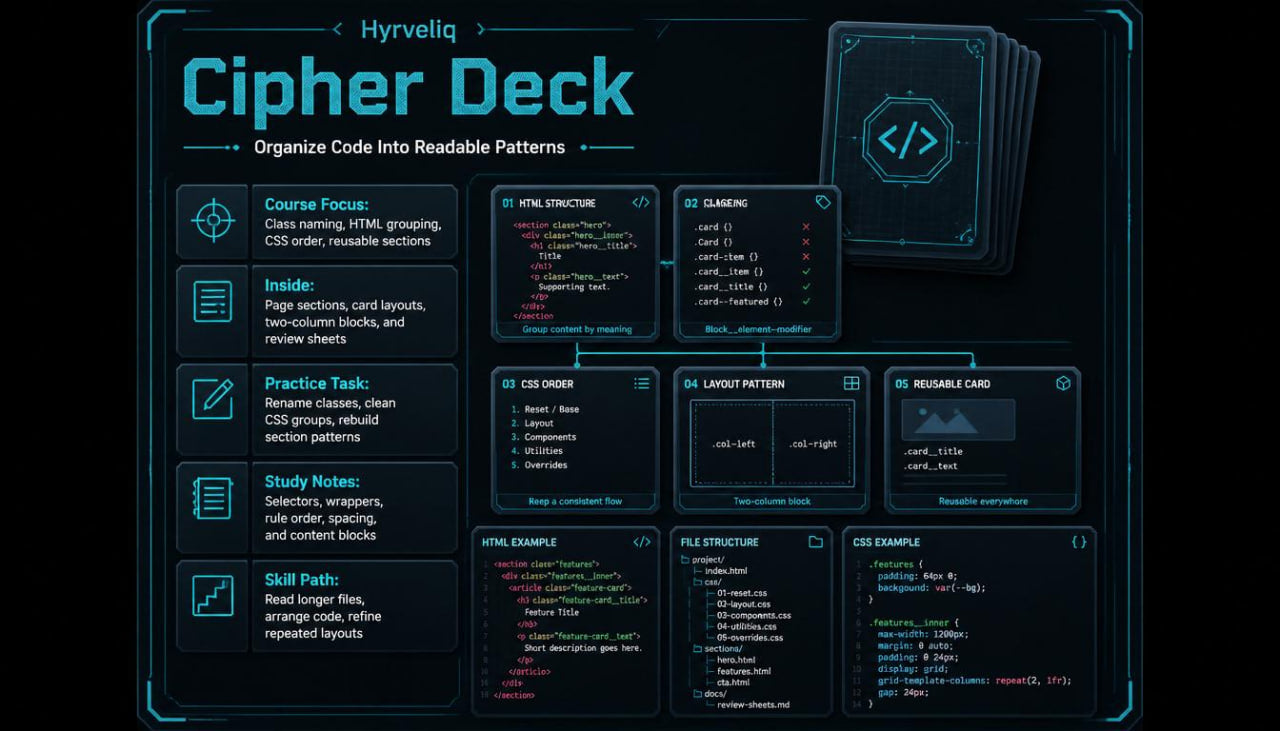
Cipher Deck gives learners a structured course path centered on code organization and reusable page patterns. The course explains how to name sections, group related elements, arrange CSS rules, and keep styling choices easier to review. Learners study how repeated blocks can be built with consistent markup and adjusted through thoughtful CSS. Each module turns abstract code ideas into practical page-building habits. The course helps learners move from isolated practice into a more organized HTML/CSS workflow. -
What’s Inside
Cipher Deck includes a detailed collection of lessons, modules, and practice materials focused on structure, naming, layout rhythm, and reusable design patterns. The course begins with an orientation module that explains how to think about a webpage as a set of connected sections rather than a pile of separate elements. Learners are introduced to a planning approach where each section has a purpose, each class name has meaning, and each CSS rule has a place.
The first core module focuses on HTML structure for multi-section pages. Learners work with header areas, introduction blocks, text sections, feature groups, card layouts, comparison areas, and contact prompts. The materials explain how to organize these sections in a readable order and how to avoid unnecessary nesting. Learners study the difference between content structure and visual styling, so the markup remains understandable before CSS is added.
The second module explores class naming. Learners see how meaningful names can make code easier to read and maintain during practice. The course covers section names, element names, modifier-style naming, and repeated patterns. Instead of using random labels, learners practice naming blocks based on their role inside the page. This helps create a cleaner connection between HTML and CSS.
The third module focuses on CSS grouping and rule order. Learners explore how to arrange general styles, section styles, typography rules, spacing rules, and reusable utility-style helpers. The course explains why scattered CSS can become hard to review and how a thoughtful order can make future edits smoother. Learners practice turning messy style examples into cleaner organized versions.
The fourth module introduces reusable layout patterns. Learners build small content cards, grid-like section arrangements, two-column content areas, callout blocks, and resource lists. Each pattern is explained with HTML structure first, then CSS styling. This makes it easier to understand how the visual result comes from the underlying structure.
The fifth module includes a guided page exercise where learners combine multiple sections into one cohesive HTML/CSS page. The page includes a main introduction area, a short course overview, a structured benefits section, a small collection preview, and a contact area. Learners are guided through planning, markup, styling, spacing, and review.
Cipher Deck also includes review sheets with common class naming examples, spacing notes, section-planning prompts, and CSS organization reminders. These materials help learners revisit important ideas without searching through long notes. Practice tasks appear throughout the course, inviting learners to rename classes, reorganize CSS, refine spacing, and rebuild section patterns in their own words.
-
Who Is This For?
Cipher Deck is for learners who already know basic HTML and CSS but want a more organized way to build page sections. It fits people who can write simple markup and styling rules, yet feel unsure when a layout grows beyond a few elements. It is also useful for learners who want cleaner code habits before moving into wider layout practice.
This course may fit students, creative learners, small site builders, and anyone who wants to improve code readability. It is especially suitable for learners who enjoy structure and want their HTML/CSS files to feel easier to review.
Cipher Deck is not aimed at advanced developers working with complex systems. It stays focused on HTML/CSS organization, section planning, repeated patterns, and readable styling habits.
- What You’ll Learn
- How to plan a webpage as a set of connected sections
- How to write cleaner HTML for multi-section layouts
- How to choose meaningful class names
- How to connect class names with CSS rules
- How to organize CSS by purpose and section
- How to reduce messy or repeated styling
- How to create reusable content cards
- How to build two-column sections and callout blocks
- How to arrange page spacing with more control
- How to review longer HTML/CSS files
- How to rebuild small layout patterns through practice
- How to prepare for broader layout-focused Hyrveliq courses
-
Refund Terms
Cipher Deck includes a 30-day refund window. Learners may request a refund within 30 days according to the store’s refund terms. This gives time to review the course materials and decide whether the learning format fits personal study needs.
Self-paced learning overview
- 🗂️ Digital file available after purchase
- ♾️ Long-term availability
- 🔐 Secure checkout
- 🗓️ Content updated in 2026
Do I need prior coding knowledge?
Do I need prior coding knowledge?
No prior coding background is required for beginner-friendly courses. Each course explains core ideas in a calm, clear way, with examples that help learners follow the structure of HTML and CSS.
What materials are included in the courses?
What materials are included in the courses?
Depending on the tier, learners may receive lessons, modules, written materials, layout examples, practice tasks, code references, and page-building exercises.
Can I study at my own pace?
Can I study at my own pace?
Yes. Hyrveliq courses are designed for self-paced learning, so learners can review materials, revisit examples, and move through modules in a rhythm that fits their schedule.
Share