Hyrveliq
Free Node
Free Node
Couldn't load pickup availability
-
Problem Statement
Many beginners open a code editor and see unfamiliar tags, brackets, rules, and layout terms without knowing where to begin. HTML and CSS can feel scattered when learners jump between random examples without a clear learning path. Some materials explain syntax but do not show how structure and style connect inside a real page. Others move from one idea to another without enough breathing room, which can make the learner feel lost. Free Node was created for people who want a small, friendly entry point before choosing a deeper HTML/CSS course. -
Solution
Free Node introduces HTML and CSS through short, focused lessons that explain the role of each part of a simple webpage. Instead of overwhelming the learner with too many topics at once, it begins with page structure, text elements, links, sections, spacing, color, and basic styling logic. The course helps learners see how HTML creates meaning while CSS shapes appearance. Each module is arranged to support steady progress through examples, notes, and small practice tasks. Free Node gives learners a useful foundation for deciding which Hyrveliq course path fits their goals. -
What’s Inside
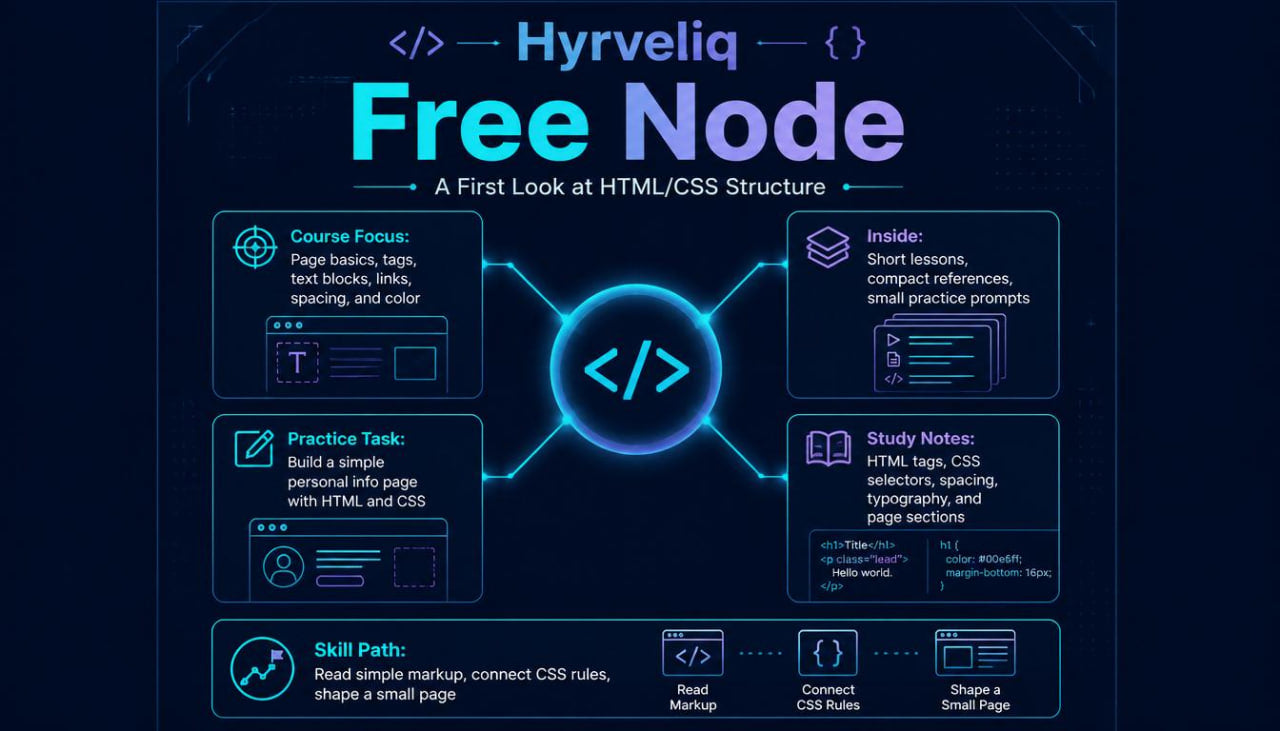
Free Node includes a beginner-focused set of materials created to introduce the core building blocks of HTML and CSS. The course begins with a welcome module that explains how the learning path is organized and how to approach the materials without pressure. Learners are then introduced to HTML as the structure layer of a webpage, including headings, paragraphs, lists, links, images, sections, and page hierarchy.
The next part explains how CSS works as the styling layer. Learners explore selectors, properties, spacing, color usage, font styling, borders, and simple layout behavior. The materials show how a plain HTML page changes when CSS rules are added step by step. This makes it easier to understand the relationship between content and presentation.
Free Node also includes small practice prompts. These prompts ask learners to adjust text, organize page sections, apply spacing, change visual details, and compare different styling choices. The goal is not to build a large final project, but to help learners notice how small code changes affect the page.
The course also contains a compact reference section with common HTML tags and CSS properties. This section is useful when learners want to revisit a term or check how a simple rule is written. Instead of searching through scattered notes, learners can return to one organized area.
There is also a mini page exercise where learners combine the ideas from the course into a simple personal information page. This exercise brings together headings, short text blocks, lists, links, spacing, background styling, and basic visual hierarchy. It gives learners a small but complete practice moment.
Free Node is intentionally light in scope. It does not try to cover every topic in HTML and CSS. Instead, it gives learners a thoughtful introduction that makes the larger Hyrveliq course collection easier to understand.
-
Who Is This For?
Free Node is for learners who are curious about HTML and CSS but want a calm starting point before choosing a larger course. It fits people who have seen code before but do not yet understand how page structure and styling work together. It is also helpful for learners who tried random tutorials and now want a more organized introduction.
This tier is suitable for students, creative learners, small project builders, and anyone who wants to understand the basic language of webpages. It may also help people who work with digital content and want to understand what sits behind page layouts, text blocks, buttons, sections, and visual styling.
Free Node is not meant for advanced learners who already build full layouts with HTML and CSS. It is also not meant for learners looking for deep coverage of responsive layouts, complex CSS architecture, or multi-page builds. Instead, it serves as a gentle entry point into the Hyrveliq learning style.
- What You’ll Learn
- How HTML gives structure to a webpage
- How headings, paragraphs, lists, and links are written
- How page sections can be organized in a clear order
- How CSS changes colors, spacing, borders, and typography
- How selectors connect CSS rules to HTML elements
- How small style changes affect the look of a page
- How to read simple HTML/CSS examples with more clarity
- How to combine structure and styling in a small page exercise
- How to use a compact reference section while practicing
- How to prepare for deeper Hyrveliq course paths
-
Refund Terms
Free Node has no paid checkout, so there is no payment to refund for this tier. For paid Hyrveliq courses, learners may request a refund within 30 days according to the store’s refund terms. This policy is designed to give learners time to review the materials and decide whether the course fits their learning needs.
Self-paced learning overview
- 🗂️ Digital file available after purchase
- ♾️ Long-term availability
- 🔐 Secure checkout
- 🗓️ Content updated in 2026
Do I need prior coding knowledge?
Do I need prior coding knowledge?
No prior coding background is required for beginner-friendly courses. Each course explains core ideas in a calm, clear way, with examples that help learners follow the structure of HTML and CSS.
What materials are included in the courses?
What materials are included in the courses?
Depending on the tier, learners may receive lessons, modules, written materials, layout examples, practice tasks, code references, and page-building exercises.
Can I study at my own pace?
Can I study at my own pace?
Yes. Hyrveliq courses are designed for self-paced learning, so learners can review materials, revisit examples, and move through modules in a rhythm that fits their schedule.
Share