Hyrveliq
Halo Map
Halo Map
Couldn't load pickup availability
-
Problem Statement
Many learners begin a page by writing code right away, then realize later that the structure feels unclear. Sections may appear in an odd order, headings may not guide the reader well, and styling may be added only to fix problems after they appear. This can lead to repeated edits, scattered class names, and page layouts that feel harder to adjust. HTML and CSS become less frustrating when the learner first understands what the page is meant to say and how each section should support that message. Halo Map was created for learners who want a calmer planning method before building full page layouts. -
Solution
Halo Map introduces a practical planning process for HTML and CSS page creation. The course shows how to sketch a page structure, group content into sections, choose meaningful headings, and prepare styling rules with a clear purpose. Learners move from page idea to section map, then from section map to HTML, and finally into CSS styling. Each module connects planning with writing code, so the learner can understand why each section exists and how it should look. The course supports a steadier workflow for building pages with cleaner structure and more thoughtful styling. -
What’s Inside
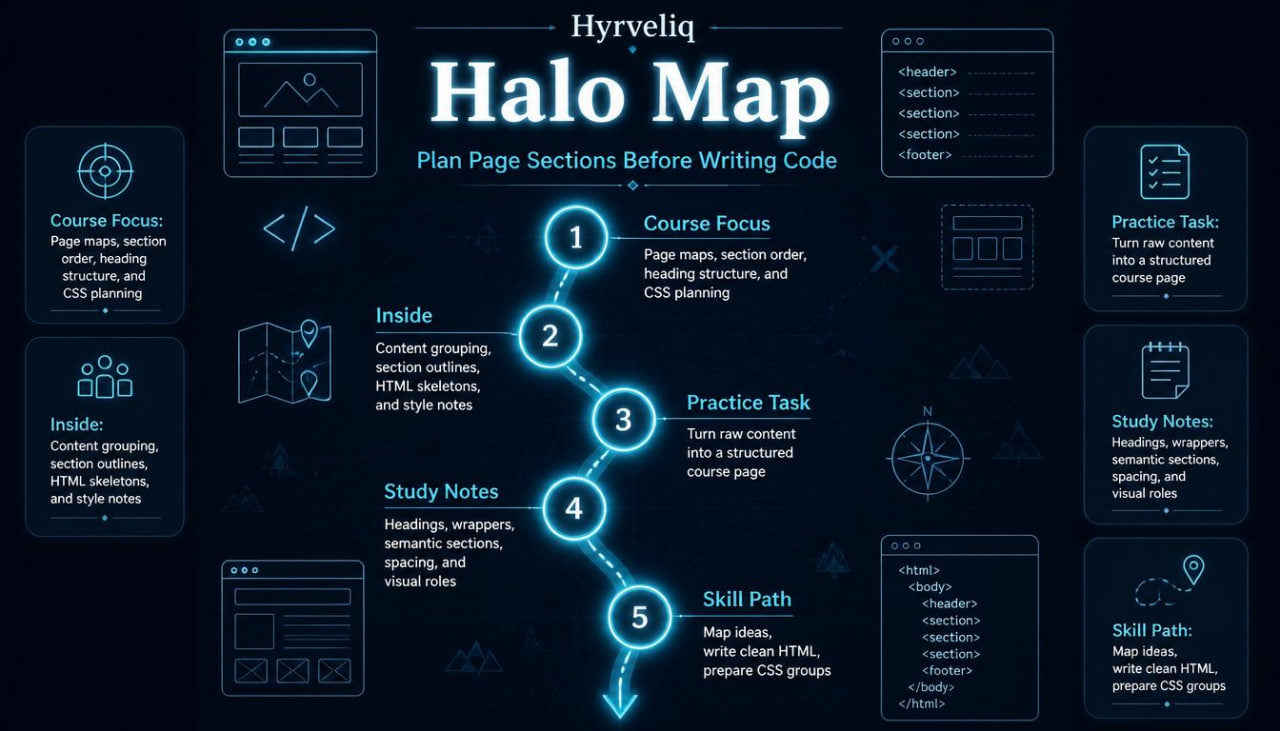
Halo Map includes a detailed set of modules, materials, and practice tasks focused on planning HTML/CSS pages before building them. The course begins with a welcome module that explains the idea of a page map. Learners study how a webpage can be viewed as a journey through sections: introduction, explanation, course overview, feature area, learning notes, FAQ, and contact prompt.
The first module focuses on content grouping. Learners practice taking raw text and arranging it into meaningful blocks. The materials explain how to separate main ideas from supporting details, how to choose section labels, and how to decide which information should appear first. This helps learners avoid pages that feel like a stack of unrelated text areas.
The second module explores heading structure. Learners study how headings guide the reader through a page and how smaller text elements support each heading. The course covers main headings, section headings, short descriptions, labels, and supporting notes. Learners compare examples where headings are too vague with versions that feel more useful and easier to follow.
The third module turns the content plan into HTML. Learners write page sections with semantic structure, organized wrappers, grouped text, and reusable class names. The course explains how planning first can make HTML cleaner because each section already has a role before the code begins. Practice tasks ask learners to build page skeletons from section maps.
The fourth module focuses on CSS preparation. Learners create styling groups for typography, spacing, section backgrounds, buttons, cards, and content blocks. The materials explain how to avoid random styling by deciding which visual choices belong to the full page and which belong to a specific section. Learners practice building a CSS outline before filling in the details.
The fifth module introduces guided page mapping exercises. Learners receive sample course page ideas and turn them into section plans. They decide where the main message should sit, how supporting blocks should be arranged, and where contact or FAQ content should appear. After planning, they convert the map into HTML and CSS.
Halo Map also includes reusable planning sheets. These materials help learners outline page goals, section roles, heading ideas, content blocks, and style notes. There are also review prompts for checking whether a page feels organized before final edits are made.
The course includes a full practice build where learners create a structured course page from a written outline. They begin with raw content, build a page map, write HTML sections, style the page with CSS, and review the layout for clarity. This process helps learners see how planning and coding can work together instead of feeling like separate tasks.
-
Who Is This For?
Halo Map is for learners who already know basic HTML and CSS and want to improve how they plan pages before building them. It fits people who can write simple sections but often feel unsure about order, structure, or content placement. It is also useful for learners who want a more organized method for turning ideas into page layouts.
This course may fit students, creative learners, course page builders, and anyone who wants to develop a practical planning habit before writing code. It is especially helpful for learners who enjoy structure, outlines, and visual organization.
Halo Map is not focused on complex development systems or advanced CSS architecture. It stays centered on page planning, section mapping, HTML structure, and CSS preparation. It is a fitting step for learners who want their pages to feel more intentional from the first outline to the final styling pass.
- What You’ll Learn
- How to plan a webpage before writing HTML
- How to divide raw content into clear page sections
- How to choose headings that guide the reader
- How to arrange supporting text under each section
- How to create section maps for course pages
- How to turn a page outline into HTML structure
- How to use semantic elements in practical layouts
- How to prepare CSS groups before styling details
- How to organize typography, spacing, and section styles
- How to connect planning sheets with code practice
- How to review a page map before final styling
- How to build a course page from a written outline
-
Refund Terms
Halo Map includes a 30-day refund period. Learners may request a refund within 30 days according to the store’s refund terms. This gives time to review the materials and decide whether the course format fits their study needs.
Self-paced learning overview
- 🗂️ Digital file available after purchase
- ♾️ Long-term availability
- 🔐 Secure checkout
- 🗓️ Content updated in 2026
Do I need prior coding knowledge?
Do I need prior coding knowledge?
No prior coding background is required for beginner-friendly courses. Each course explains core ideas in a calm, clear way, with examples that help learners follow the structure of HTML and CSS.
What materials are included in the courses?
What materials are included in the courses?
Depending on the tier, learners may receive lessons, modules, written materials, layout examples, practice tasks, code references, and page-building exercises.
Can I study at my own pace?
Can I study at my own pace?
Yes. Hyrveliq courses are designed for self-paced learning, so learners can review materials, revisit examples, and move through modules in a rhythm that fits their schedule.
Share