Hyrveliq
Neon Library
Neon Library
Couldn't load pickup availability
-
Problem Statement
At a later learning stage, many learners can build individual HTML and CSS sections, but connecting them into a polished full page can still feel challenging. A layout may contain useful parts, yet the overall page can lose rhythm when sections, cards, headings, and contact areas are placed together. CSS files can become long, repeated rules can appear in several places, and class names may stop feeling clear. Learners may also need a better way to review their own pages, identify uneven spacing, and adjust repeated patterns. Neon Library was created for learners who want a wider course path for building, organizing, and refining HTML/CSS page systems. -
Solution
Neon Library guides learners through a detailed HTML and CSS workflow built around reusable page libraries. The course explains how to plan a page, create structured HTML sections, write organized CSS, refine repeated layouts, and review the final result with care. Learners work with content blocks, card groups, page sections, reference notes, and full-page exercises. Each module connects a practical coding task with a clear reason behind the structure and styling choice. The course helps learners develop stronger page-building habits through detailed materials, guided examples, and thoughtful review steps. -
What’s Inside
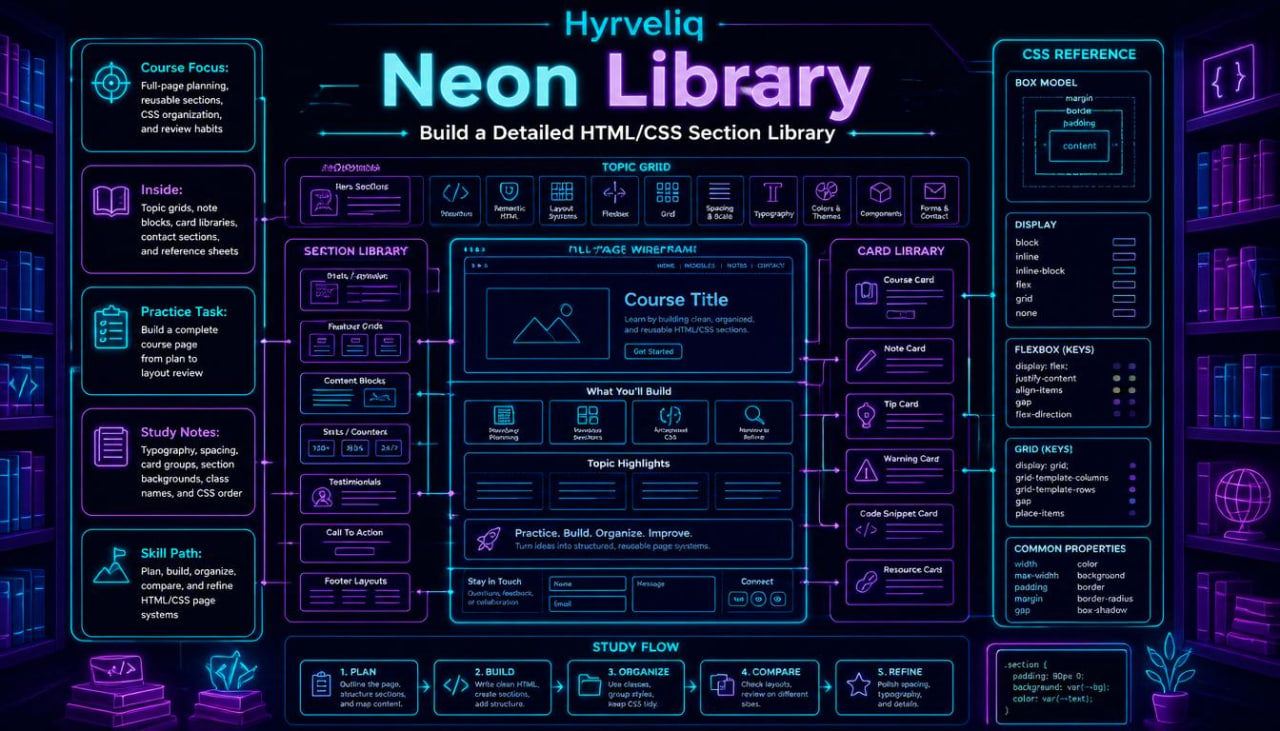
Neon Library includes a wide set of lessons, modules, reference materials, and guided exercises focused on building a complete HTML/CSS section library. The course begins with an orientation module that explains how to treat a webpage as a connected system of reusable parts. Learners explore how headings, containers, cards, text groups, lists, section backgrounds, spacing values, and contact areas can work together across a full page.
The first module focuses on page planning. Learners create a written page outline before writing code. This outline includes the main opening section, course overview, learning notes, section groups, resource areas, FAQ preview, and contact prompt. The materials explain how each page part should have a clear role, so the layout has direction before HTML begins.
The second module focuses on structured HTML. Learners study how to build reusable section markup with wrappers, containers, inner groups, heading blocks, card rows, and supporting text areas. The course explains how to keep markup readable when a page grows longer. Practice tasks ask learners to rewrite loose page sections into cleaner, grouped structures.
The third module focuses on CSS organization. Learners create separate rule groups for base styling, typography, spacing, containers, cards, section backgrounds, links, and responsive layout behavior. The course shows how organized CSS can make review and editing less confusing. Learners practice moving scattered rules into clearer sections and comparing the difference.
The fourth module explores refined spacing. Learners study section gaps, inner padding, card spacing, heading margins, paragraph rhythm, and full-page vertical flow. The materials explain how spacing can guide attention and make page content feel easier to follow. Practice tasks invite learners to compare tight, loose, and balanced spacing versions, then describe what changed.
The fifth module introduces reusable visual sections. Learners build several HTML/CSS patterns, including a course overview area, topic grid, learning notes section, resource cards, FAQ preview, and contact block. Each section is built from markup to styling, then reviewed for structure, spacing, and clarity. Learners are encouraged to rebuild each pattern in their own words to strengthen understanding.
The sixth module focuses on card libraries. Learners create several card types, including compact cards, detail cards, checklist cards, and course preview cards. The course explains how to manage varied text lengths, internal spacing, heading hierarchy, and repeated visual details. Learners also practice adjusting card groups so they remain organized within wider page sections.
The seventh module covers typography systems. Learners review heading levels, paragraph sizing, label text, small notes, line height, and content grouping. The materials show how text choices affect the reading flow of a page. Practice tasks ask learners to refine headings, shorten supporting descriptions, and align text styling across several sections.
The eighth module focuses on full-page review. Learners study how to inspect a layout from top to bottom, checking section order, repeated spacing, class names, card alignment, text hierarchy, and visual consistency. The course includes review prompts that can be reused during personal practice. These prompts help learners notice issues before adding extra code.
Neon Library also includes a guided final build. Learners create a complete HTML/CSS course page using the section library developed throughout the course. The build moves through planning, HTML structure, CSS styling, spacing refinement, card organization, typography review, and final layout review. Supporting materials include page outline sheets, section templates, class naming notes, spacing references, CSS review prompts, and reusable code examples.
-
Who Is This For?
Neon Library is for learners who already understand HTML and CSS basics and want a fuller course path for organized page building. It fits people who can build several sections but want deeper practice with reusable layouts, CSS structure, spacing review, and page-wide consistency.
This course may fit students, creative learners, small site builders, course page creators, and anyone who wants a structured way to develop practical HTML/CSS materials. It is especially useful for learners who enjoy detailed examples, reusable sections, and organized references they can revisit during study.
Neon Library is not focused on complex engineering systems or third-party tools. It stays centered on HTML/CSS structure, reusable section libraries, page layout, CSS organization, and review habits. It is a fitting final tier for learners who want to bring many page-building ideas into one structured learning path.
- What You’ll Learn
- How to plan a full HTML/CSS page before writing code
- How to organize a page into reusable sections
- How to write cleaner HTML wrappers, containers, and content groups
- How to group CSS rules by role and section
- How to create reusable course overview areas
- How to build topic grids, note blocks, and contact sections
- How to create compact cards, detail cards, and checklist cards
- How to manage spacing across a longer page
- How to refine heading hierarchy and paragraph rhythm
- How to review class names for clarity
- How to compare several layout versions during practice
- How to build a complete course page from planning to final review
- How to create a personal HTML/CSS reference library
- How to revisit and refine page sections through guided prompts
-
Refund Terms
Neon Library includes a 30-day refund window. Learners may request a refund within 30 days according to the store’s refund terms. This gives time to review the course materials and decide whether the learning format fits personal study needs.
Self-paced learning overview
- 🗂️ Digital file available after purchase
- ♾️ Long-term availability
- 🔐 Secure checkout
- 🗓️ Content updated in 2026
Do I need prior coding knowledge?
Do I need prior coding knowledge?
No prior coding background is required for beginner-friendly courses. Each course explains core ideas in a calm, clear way, with examples that help learners follow the structure of HTML and CSS.
What materials are included in the courses?
What materials are included in the courses?
Depending on the tier, learners may receive lessons, modules, written materials, layout examples, practice tasks, code references, and page-building exercises.
Can I study at my own pace?
Can I study at my own pace?
Yes. Hyrveliq courses are designed for self-paced learning, so learners can review materials, revisit examples, and move through modules in a rhythm that fits their schedule.
Share